


Almost everyone who has dealt with sphinxes, claim that this is the most lovable breed of all, ever been created in the world. Special character - one of the typical features as a sphinx, as its naked hot body and unusual appearance. It seems that, together with a wool Sphinx has lost a significant part of cat behavior. I think well of all representatives of the cat world, I like many of the breed, in its own beautiful and wonderful, but I would just like to emphasize that the Sphinx - it is not already a cat! It is obvious that something is going on with the psyche of the animal under the influence of mutation, radically changing its appearance. Ask about it the owners of hairless dogs - Mexican, Peruvian or Chinese Crested they all in one voice say that their pets - are not quite dogs: they are very affectionate and completely devoid of aggression! However, they believed them not just dogs but special assistants of a man having magical properties. Now there are three breeds of hairless cats: Canadian Sphynx: Sphynx and two - derived in Russia - Donskoy Sphinx (Lysak) and Peterbald. However, international recognition of felinologists has been got only by Canadian Sphynx, about which will be discussed further.
Mention of hairless cats can be found in antiquity. In our time, such reports periodically appeared in print for over 100 years. It is believed that hairless cats were still the Aztecs, which seems likely, because they were as naked dogs!
As for the cats, the last representatives of the ancient breed called the Mexican Hairless, shown at cat shows in the United States at the beginning of this century. Before the start of the 30s survived only a couple, unfortunately, and without issue. According to the description, Mexican cat differed from modern sphinxes: they had elongated body, long tail, wedge-shaped head with large ears, amber eyes and long antennae, which are almost completely devoid of sphinxes. In winter, on the back and tail grew short fur, which disappeared in the summer. There was an unknown mutation of the genetics: if a sign hairless transmitted by recessive or dominant fashion. In the latter case it is possible that our domestic and Mexican (Don Lisak) hairless cats were genetic twins. Anyway, for those and other stored mustache when hairlessness, both breeds tend to dress for winter in the "fur coat".
The individual cases of the appearance of hairless kittens in litters of normal cats were observed throughout the world. However, until recently, in no one case there was an attempt to create a new breed. The emergence of the breed of hairless cats is associated with 1966, when in Ontario, Canada, among kittens normal domestic cat was discovered hairless kitten, named Prune. After the allotted time Prune was crossed with his mother and litter appeared normal and hairless kittens. As long as it was possible, Pruna drove its daughters, granddaughters, perhaps more to save the original gene. The result was two varieties of sphinxes, slightly different appearance. Soon, however, the United States and Canada have ceased to breed Sphynx. In 1971 CFA withdrew the temporary status of the species, given to her before. In what was the matter? Breeding Sphynx failed for several reasons.
Firstly, the breed was very small in number, and there was no hope to stabilize it using available to the breeders of animals. In addition, breeders have not understood in genetics sphinxes. Mistakenly believe that the sign is associated with hairless sex. Secondly, Sphynx kittens appeared to be more demanding of care, than their conventional counterparts, and often died. And, thirdly, the breed was unsuccessful breeding strategy in the first nurseries.
The story could have ended sphinxes, if not a new discovery. In 1975, Vaden, Minnesota, a simple short-haired cat gave birth of a bald cat, not without humor, called the Epidermis. A year later, the cat was born there. Both animals were in Z.Stardust cattery in Oregon where Epidermis became the founder of the elite breed lines today. At the end of the 70s on the streets of Toronto, near the location of the first sphinxes, three new kitten was found: a black and white cat, named Bambi, and two cats. Unfortunately, the state of Bambi when he was found, it was horrible, one eye was punctured and leaked, and needed emergency surgery to remove his severely damaged testicles. So Bambi did not have to be the progenitor of the breed, although its beautiful style deserves this. But Bambi famous for something else: today it is - the champion of longevity among sphinxes, lived a long and happy life, and finished it after his 19th birthday (!). The other two cats, named Pinky and Paloma, were sent to the Netherlands, where they became the founders of the European breed line.
In the future, to maintain the genetic pool of the breed Sphynx, and in Europe and America received the kittens were crossed both with sphinxes, and with the Devon Rex. Selecting the Devon Rex has been very successful: their type and appearance was closest to the sphinxes, besides devons were the only breed with breedings which is already in the first generation born hairless kittens.
However, it should paid for everything. Such a massive rush of blood other, although genetically close breed, was not in vain for the Sphynx. Unfortunately, often the modern sphinxes of some lines resemble bald Devons of mediocre type: thin skin, a bit short "Devon" head with too round for the sphinx eyes, low, as in the Devonian, set ears, sometimes legkovat for Sphinx bony body - a clear sign of breed degeneration . Such a characteristic feature of the first sphinxes wrinkled skin, making them look like little old men, is becoming increasingly rare in adults sphinxes. It is true that kittens are still wearing "pajamas bigger", but with age, the folds apart, staying in the best case on the head, in an ideal - and even on the neck. Sphinxes many modern lines, particularly in Europe and originating from them, the US seems to be more on fine porcelain figurines than wonderful wrinkled gnomes as they look at first. Perhaps the most "folded" at the moment Canadian Sphynx - a line animals originating from the legendary epidermis, although they are far from their "ancestor".
New hairless natural mutations occur occasionally and are now in the American continent. Such animals are very appreciated and it is tried to make maximum use of their potential for breeding. "New hairless" usually become a pride of catteries.
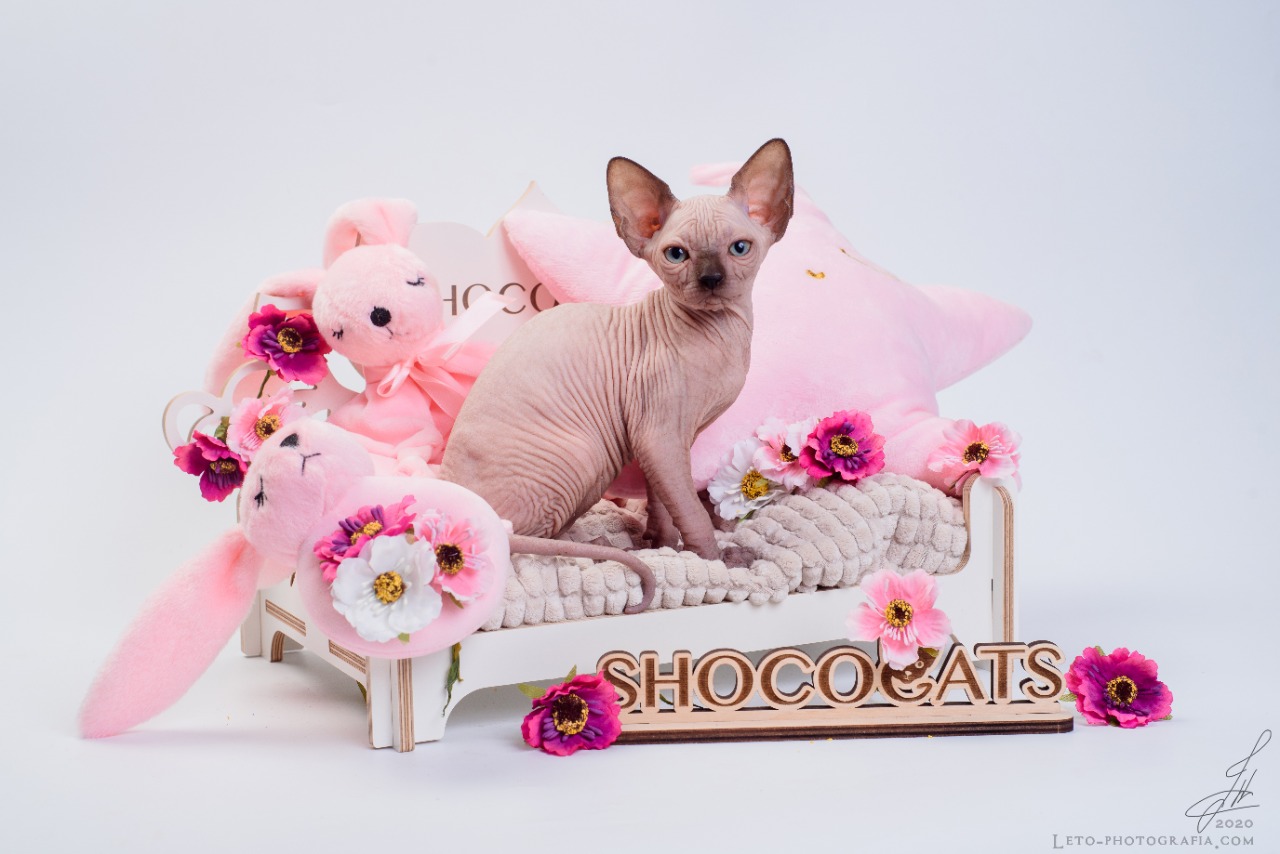
Canadian Sphynx - is not just a naked cat. Of course, the lack of hair - the very first distinctive feature, but not the only one. The morphology of the head, eyes, and even the nature of the need to meet a number of very strict criteria defined by the breed standard. Look at the good Sphinx is literally magic. And it's not just hairless or big ears. The Sphinx is a special, inherent only to him harmony, any deviation from which makes it just a nice kitty without wool. Sphynx has an amazing soft outlines. His figure is not a single straight line, they are rounded, convex and all forms, however, are fluid, flowing. In this it resembles a Chinese statuette (perhaps so the second, less well-known name of the Canadian sphinx - "moon cat"). Even the front legs at the sphinx slightly curved in the manner of "Bulldog", and the tail is very flexible and always smoothly bent or pressed against the side of a dense "bagel". The ears are large and wide, and their ends are necessarily rounded. Another feature inherent in Canadian Sphynx - thick skin forming folds. Kittens up to one month entirely in the "crease", including the tail and paws. With age, the wrinkles are smoothed out, and they are in adult animals on the head, neck, abdomen, and a bit on the trunk, which gives them a distinctive look "old men." The more conserved folds adult sphinx - the better, and the lack of folds is considered a vice. The body of the cats of this breed thick and muscular. They should not be "fry", on the contrary, in the form of belly like a pear, creating the impression that the cat has eaten well. Hind legs longer than the front, which is why the Sphinx in a very peculiar gait. The skin feels like suede - because of its very short coating gun. Fur is retained at all sphinxes on the nose with the back of the ears, it may be a small amount to the ends of the legs and tail. In addition, at these locations the wool can occur when the wrong feeding, at a lower temperature or with hormonal changes during ripening. Colors Sphynx easily distinguishable thanks to strong pigmentation of the skin. The most common of them - piebald (bi- and tricolor colors, ie, different variants of the basic color white) and white (with this color look like sphinxes pink). Several less common solid colors and different options tortoise. Very beautiful, as, indeed, and rare colors are grouped under "Minkov": Such animals with gentle lightening the basic color has a beautiful light blue eyes, although not as bright as those familiar Siamese or blue-eyed pets white color.
It has been said that the character of sphinxes is not from the cats. It seems that cats themselves and they do not consider: good-natured, peaceful, affectionate to man, often prefer someone from one family, not afraid of dogs and other animals, as if they had almost no feline instincts, easily trained. We are beholden to their fellow man and are "equals", "human being". Communication with the Sphinx is always very nice, perhaps because of the lack of hair there is a feeling of contact not with an animal, but with a creature standing on a step closer to the man - and how to know if only in appearance?
Lifespan of Sphynx is the same as that of other cats. Interestingly, the centenarians were many first sphinxes: Paloma and Epidermis lived to 16.5 years, already mentioned Bambi lived to be 19, but the record of longevity, not only among the sphinx, but all cats, according to the magazine "Cat Fancy Magazine" ( March 1997) was the cat Granpa Rexs Allen, sphinx hybrid with Devon Rex. This venerable cat lived for about 30 years, 12 of which were devoted to the exhibition career.
Those interested in the genetics of hairless animals, obviously, know that the mutation that causes hairlessness in Sphynx is recessive: heterozygous, in combination with a "normal" gene is present in all cats have fur, hairless sphinx gene is phenotypically not shown (ie. hybrid animals of the first generation will have normal hair). Symptom hairlessness is manifested only in the homozygous ( "clean" from the impurity of the "normal" gene) condition when the animal has a double set of gene hairless Sphynx, the genetic designation which hr. The exception to this rule only with the combination of re gene responsible for the sign in wavy wool Devon Rex. According to it hairless sphinx gene - dominant, ie, phenotypically manifest in the heterozygous state (for example, hybrid animals of the first generation).
But not all so simple. The dominance of the hairless gene in this case is not complete. Heterozygous for this trait kittens partially retain wool. It can be on the legs, tail, sometimes - to a greater or lesser extent - on the sides, usually from the muzzle of cats heavily overgrown, wool may extend beyond the eyes to form a wool "mask". But the degree of overgrown heterozygous animals can be very different, even with seemingly the same genetic formula. This is most clearly in hybrid kittens litter (Sphynx Devon Rex X) of the first generation: there may be a complete alignment - from almost completely naked animals to fur-covered undulating around the body. However, in the latter case, a kitten with age partially lose hair, but she will remain on the tail, legs, head, perhaps a little on the sides. But also the hybrid hairless kitten on the body are reduced short hairs, more visible and tangible, than the purebred Sphynx.
Interestingly, the main difference between the hybrid kittens - it is not even a degree of overgrownness and not the type that can also vary greatly among the kittens from the same litter - from extreme close-up full sphinginae "Devon" (as a rule, more overgrown kittens). Unlike most indicative - the skin. Kittens that are thoroughbred sphinxes have it from the birthday fat accumulating in distinct relief folds, which makes them look just unique. By hybrid kittens skin is much thinner, more like a normal cat skin, wrinkles may also be present, but not so clearly as in these sphinxes. When backcrossing to purebred Sphynx kittens are becoming more and more "sphinginae" around the complex of signs, though in each litter will always be observed cleavage and partial return to the type of Devon Rex, which is manifested in excessive overgrown, shortened broad head (like bad Devon Rex), a characteristic "Devon" put ears (below and slightly to the side, rather than up, like sphinxes).
Among breeders breed Sphynx can be divided on the homozygous (ie, carrying a pair hairless gene - hrhr) and heterozygotes (carrying the gene hairless hr in combination with gene re Devon Rex). However, most proudly declare that their sphinxes are real, ie, homozygous. In fact, even the presence of a pedigree, which are completely absent Devon Rex, does not in itself ensure a homozygosity. In the genetic pool of the breed there is a lot of "Devon" genes because of the massive use of Rex more on becoming a rock, and still are binding - not bone. To distinguish homozygous sphinx from heterozygous it is possible not by pedigree, but by appearance, especially at birth: homozygous kittens are born completely bald, with no evidence of any kind was wool, and later they have a hair on the nose (but only on the nose, it does not go in the face!), fine wool growing on the top half of the ear and ... everything! Heterozygous sphinxes are always born even with a small and very weak, but the fluff on the body (such as the croup). This can really get down after 1-2 weeks, and later in life to distinguish homozygous from heterozygous sphinxes will be very difficult (provided the latter has acquired the minimum), but in adulthood wool can reappear, usually in proportion to the amount that had kitten at birth. Perhaps more important in terms of dilution of common type of animal, determined by complex influence of genes and slowly improved by directed selection.
Recognition as the Sphynx breed was not easy. After Sphynx breeding failures in the first nurseries had an opinion about the extreme instability of the rock, and it is impossible to stabilize it. It is only the "second wave" in breeding, which began on repeat but found the animals allowed to create this unique breed. The breed is recognized by many feline US organizations. Here is the complete list of organizations fully recognized breeds of today:
- The International Cat Association (TICA) - International feline association, - American Cat Fanciers Association (ACFA) - The American Association of cat lovers, - American Cat Association (ACA) - The American feline association, - American Association of Cat Enthusiast (AACE) - American Association of cats breeding enthusiasts, - United feline organization (UFO) - Joint feline organizations, - Canadian Cat Association (CCA) - The Canadian Association of feline.
Most of the sphinxes are currently registered in TICA. Their number in the organization from 1982 to the present day is about 1300 animals, and added approximately 300 new sphinxes annually in recent years. But at the moment the rock is going through a significant new stage in its development. In February of this year, CFA has decided to allocate Sphynx in a special class. ("Miscellaneous class"), which means the beginning of the recognition of the breed and, in this, the largest and most conservative US organization. However, open for Canadian Sphynx class only gives the right to participate in CFA exhibitions without assigning titles; breed standard will be developed and approved by the company in collaboration with breeders for several years.
In Moscow, the first pair of Sphynx, imported from North America, there was more than four years ago. More than a year before it was in search of the catterry, negotiations, waiting, waiting ... And here are the first Sphynxes - in Russia. That was a famous cat «Pelmen» from the Canadian cattery Aztec, and Nefertiti from the cattery Grandpaws. This couple gave first offspring of Canadian Sphynxes in Russia. About a year later, in Moscow club "Russia" there was a pair of sphinxes of Belgian breeding. Now it comes the third generation (grandchildren) from Russia brought to the first animals. New animals recently brought from America and France, will expand the genetic pool of the breed and promote its cultivation in our country. In all, our fans today, there are about three dozen purebred Sphynxes, the vast majority of whom live with Moscow fans. However, recently sphinxes have begun to appear in other cities.
Historically, Russia is the only country in which there are several breeds of hairless cats - imported Canadian Sphynx and native breeds that are based on our local natural mutation, called Sphynx (Lysak) and a hybrid breed of Don Sphynx - Petersburg Sphynx or Peterbald. Moreover, if for breeding Don Sphynx, to increase the gene pool of this breed, they use a variety of local indigenous breeds, and when breeding Petersburg Sphinxes they use hybridization only with Oriental and Siamese Cats. Already developed the first standards of breeds, breed enthusiasts actively seek for international recognition among felinological organizations. It is interesting that the mutation similar to that which served as the basis for the beginning of the breeding Don Sphynx, not isolated on the territory of Russia. I had to see Moscow variants of hairless mutation, although the distance from Rostov, where it was discovered and appreciated, to Moscow - more than enough. At the same time it did not meet a hairless mutation similar occurring in the North American continent. Mutation Hr, causing hairless sphynx, is considered dominant, but it would be better to talk about incomplete dominance mutation Hr with respect to the normal gene, which determines the presence of coat, the manner of incomplete dominance hr gene (hairless Sphynx) in relation to the gene re Devon Rex. As in this, and in another case the animals first and subsequent generations without homozygous hairless gene, partial have overgrown. However, the severity and nature has acquired very different from Canadian and domestic (Don Lisakov) sphinxes. Unlike the first heterozygous Don Sphynx are born covered with a crimped, soft wool or a wire that is stored in them for a long time - from several months to a year or more. But the homozygous individuals, and a few in this breed are born completely naked, do not even have reduced the residual hair on the body and the gun in the face! At the touch of this skin is more delicate than the "thick-skinned Canadians." As a rule, for the Don Sphynx less characteristic sign of skin redundancy and mobility, so inherent in the American mutation. Especially clearly seen, when compared to the founders of rock in either case. At the heart of each breed is its mutation and a gene pool, and the task of felinologists and breeders - to guess and make more explicit that kind which is incorporated by the very nature.

